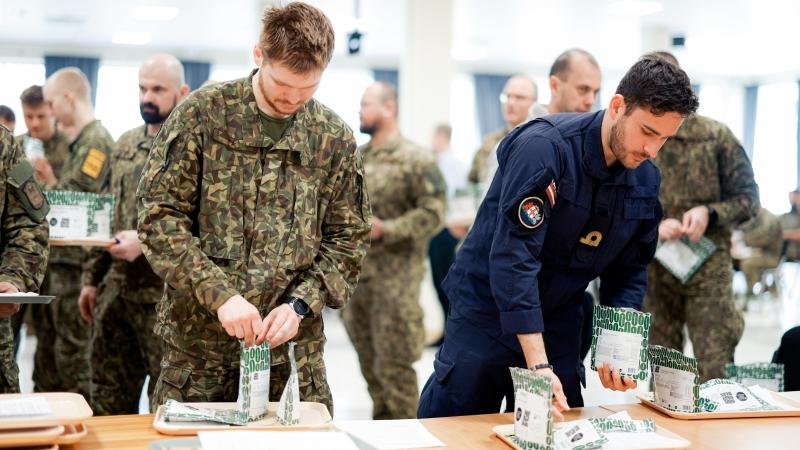
On April 29th the Latvian military website Sargs.Lv reported that a ‘food tasting’ took place at the Latvian National Defence Academy for new National Armed Forces (NAF) rations. This saw the taste-testing and evaluation of lightweight, long-lasting and nutritious freeze-dried meals.
Sargs says that the new food prototypes were created in collaboration between the company “Roga Agro” and the Institute of Food of the Latvian University of Biosciences and Technology (LBTU). Activities are taking place within the framework of a grant supported by the Ministry of Defence.
Brigadier General Kaspars Zdanovskis, Deputy Chief of the Joint Staff of the Latvian Armed Forces for Support Issues was quoted as saying:
“We live in an era when war is happening right next door. Russia, as an aggressor, is destroying the Ukrainian population, infrastructure and our fellow soldiers every day…This is a time when we need to develop not only kinetic, but also support capabilities. And food is one of the three critical ones – along with ammunition and fuel,”
Zdanovskis pointed out that the current dry rations used by Latvia’s armed forces is already of sufficient quality and taste, but one weak point remains: its expiration date. It’s reported that the new freeze-dried meals have a potential shelf life of up to 8–10 years.
This would allow the NAF to build significantly larger stocks and improve its response capabilities in times of crisis.
The current main meal, not dehydrated or freeze-dried, is the heaviest part of the package. While it’s edible right out of the package, it can be warmed up using a heat pack which is activated by chemical reaction that occurs when water is added – something fairly common with military field rations.
Sandra Muižniece-Brasava, a professor at the Institute of Food Science at LBTU, stated:
“We see this project as a success story – science and business working together to create practical and high-quality solutions,”
She pointed out that the meals were developed with dual use in mind – both for military needs and the civilian market.
So what was presented at the April 29th tasting? Well, soldiers were offered 14 different meals, of which three were vegetarian. We couldn’t find a full list but our understanding is that these meals will be military-adaptations of the already-commercially-available products under the brand Good Mood Meals.
It was stated, however, that additional work is still planned for the military version – adapting it to have a higher calorie count and higher protein content. But it’s safe to say that meals found on the company’s website are more or less the types of meals soldiers can expect to eat in the field in the near future.
We already mentioned the expected advantages of these new rations: They are to be lighter weight than existing rations while ALSO having a longer shelf life. This is achieved in a process called Lyophilization (or sublimation) – which is more commonly known as freeze-drying.
The product is initially prepared as a complete meal, then frozen to -40°C. It’s then “lyophilized” in a vacuum and later dehydrated further to eliminate any residual moisture. It is said that this process retains up to 97% of nutrients. Aroma and texture is also said to be maintained throughout this preservation process.
“This process preserves both the structure of the product, as well as the nuances of taste and valuable substances that we often lose during conventional heat treatment,”
Sargs.LV says that, to prepare a freeze-dried meal, you need to open the package, remove the oxygen absorber, and then pour in the amount of hot water indicated on the package. Mix the meal thoroughly, close the package with a special closure and leave for 10-15 minutes. If hot water is not available, it is possible to use cold water, but in this case the taste quality may be lower. The meal would be safe to consume… but to fully enjoy the taste, it’s of course recommended to use hot water.
Overall, it was reported that the mood was positive – and both the soldiers of the Land Forces Mechanized Infantry Brigade and the Navy acknowledged that the food was surprisingly tasty, with some even stating that it surpassed the previous rations! The only criticism mentioned was the practicality of quickly sourcing hot water in field conditions in the forest.
On April 7th, 2025, Lithuania’s Defence Resources Agency under the Ministry of National Defence, together with the Latvian Ministry of Defence, announced that it had signed a contract with Finnish company Marine Alutech for the purchase of multi-purpose attack boats. The value of the contract for the Lithuanian side is €22 million.
The Lithuanian ministry of defence says that this contract is the second step after the technical agreement was signed in 2024 between Latvia, Lithuania and Finland. Under this contract, Lithuania will acquire two advanced fast multi-role attack boats, which will be equipped with the SPIKE NLOS missile launch system and a remote heavy machine gun control system.
The specific model being purchased was not specified, and it sounds like there will be some development taking place. However, the photo attached to Lithuania’s press release is the Watercat M18 AMC COMBAT SUPPORT SERVICE VESSEL. Other sources say that the future boats will be based on the M18.
The Watercat M18 is already in operation with the Finnish Navy, which has 12 of these vessels. These are powered by two 660 kW Scania diesel engines and feature Rolls-Royce waterjet propulsion. Interestingly, it looks like Lithuania’s Ministry of Defence took the image from Marine Alutech, photoshopped out trees in the background, as well as the Finnish flag. The SPIKE NLOS was also added to the back – a missile launch system from Rafael Advanced Defence Systems.
It looks like this deal has been in the works for quite some time. Back in June 2022, a letter of intent was signed with Finland on the acquisition of two patrol craft.
The defence minister at the time stated:
“Finland understands the necessity of such craft to Lithuania, so the negotiations are going really fast. We are planning the sale-purchase contract to be concluded still this month. The patrol boats would complement the efforts to enhance an all-round defence, fill in the gap of Lithuanian Navy capabilities in the Curonian Lagoon and would build up Lithuania’s coastal surveillance.”
Source: LT Ministry of Defence
And so, with this quote taking place almost 3 years ago, it would appear that something delayed Lithuania’s plans…
In the recent official press release, Lithuanian Minister of National Defense Dovilė Šakalienė was quoted as saying:
“These new multi-purpose attack boats will significantly strengthen our Naval Forces and ensure a faster response to security challenges in the waters of our region. In addition, this contract is an excellent example of how small countries, by cooperating, can build a stronger and more effective defense, ensuring stability and security in the entire Baltic region,”
These boats will contribute to preventing threats from the Gulf of Finland to the Curonian Lagoon. Due to their special design and propulsion system, the boats will be able to navigate in extremely shallow waters and will allow them to quickly respond to various threats both on water and on land.
The acquisition of the boats for the Lithuanian Navy will contribute to the strengthening of local industrial sectors through industrial cooperation in both Lithuania and Latvia.
We know that Lithuania has ordered 2 for €22 million. However, Latvia has yet to commit to any sort of purchase. The Latvian Ministry of Defense has only signed an agreement to join the initial development phase as part of the cooperation. After its development, the results will be evaluated, and a separate decision of the Latvian Ministry of Defense will be made on the production and purchase of a prototype of the platform.
As the boat is still being developed, there’s not too much else to say with this news. However, we can tell you the SPIKE NLOS (which stands for Non-Line-of-Sight) is a multi-purpose, electro-optical/infrared missile system with the ability to reach ranges up to 32 kilometers. The Israeli-built system comes from Rafael Advanced Defense Systems, although the company has teamed up with Lockheed Martin to offer the weapon system to U.S. customers.
Lithuania’s forces already have a relationship with Rafael and are already familiar with Spike as an anti-tank guided missile system. This system has been installed on Lithuania’s Vilkas Infantry Fighting Vehicles.
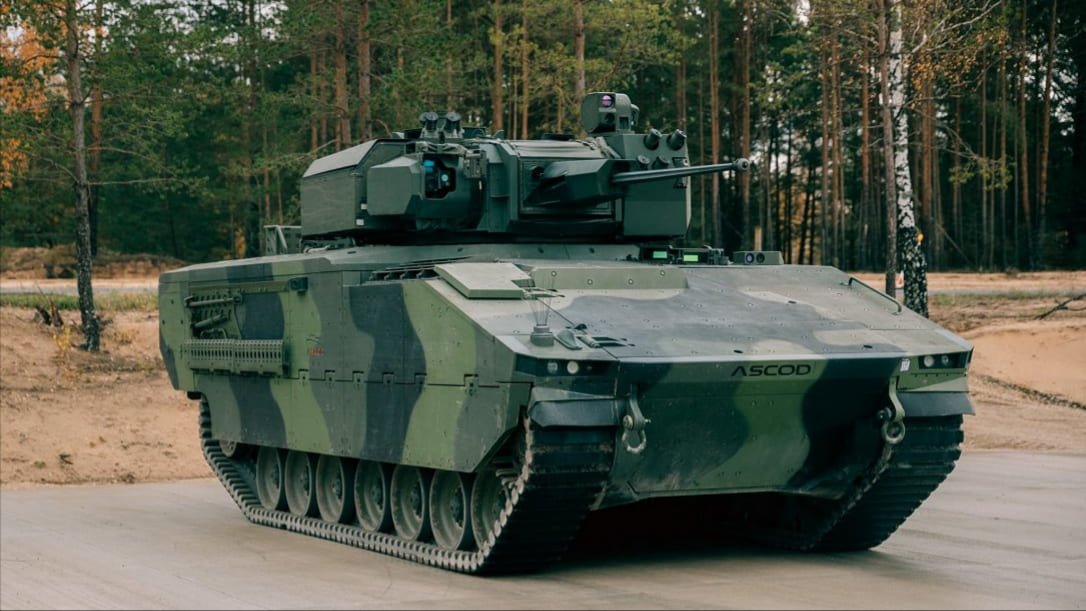
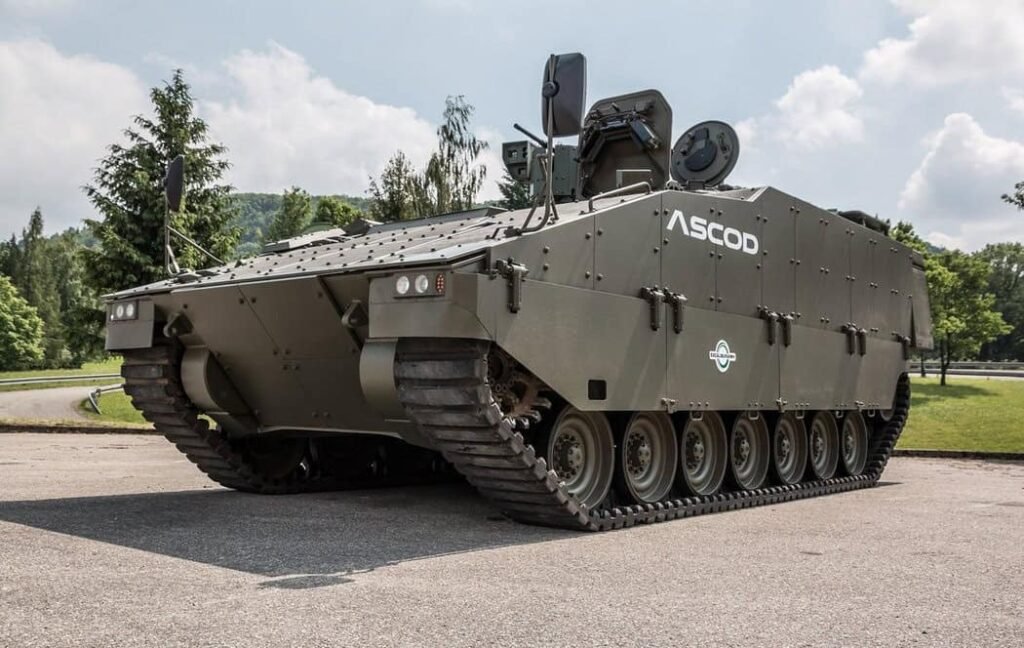
Some pretty eyebrow-raising news coming out recently regarding Latvia’s future IFV – the one based on the ASCOD platform from General Dynamics European Land Systems. Announced on May 30th, 2025, Finland’s Patria and General Dynamics European Land Systems (GDELS) will be entering into a strategic collaboration to assemble and maintain ASCOD Infantry Fighting Vehicles (IFVs) at the Defence Partnership Latvia (DPL) facility in Valmiera, Latvia.
The news came out on the fifth anniversary of Patria’s operations in Latvia and the first anniversary of the Defence Partnership Latvia (DPL) armoured vehicle production facility in Valmiera. Up until this point, it was unclear where the vehicles would be built. You may recall that, on January 30th, 2025, The Ministry of Defense of the Republic of Latvia awarded General Dynamics a contract for the delivery of an initial batch of 42 ASCOD Infantry Fighting Vehicles (IFV) including logistic support.
The acquisition decision followed an international competition with extensive functional trials by the Latvian National Armed Forces. The initial contract is stated to have a value of approximately €373M.
As stated by Patria, the ASCOD IFVs will feature NATO-standard Level 4 armour, automatic cannons, anti-tank weapon systems, machine guns, and advanced battlefield technology, providing enhanced situational awareness for troops.
At the same time, the specific cannon, anti-tank systems, etc, have yet to be disclosed.
Patria adds that each vehicle will be operated by a three-person crew and can transport and deploy six fully equipped soldiers. Uģis Romanovs, Chairman of the Board at Patria Latvia and Defence Partnership Latvia, was quoted as saying:
“Our experience with the production of 6×6 armoured vehicles, combined with the transfer of technology and expertise from Patria, demonstrates our ability to handle complex and precise military vehicle manufacturing, assembly, and maintenance tasks…We are excited to begin this collaboration with Patria, a company that has proven its technological capabilities in managing complex defence industry solutions.”
It should be made clear that the Valmiera facility will be the assembly site for the future IFVs. Thus, we don’t yet know where various ASCOD components will be produced. Nonetheless, the move will contribute significantly to the growth of the local defence industry, while also supporting the broader Latvian economy.
The procurement process for these vehicles actually began in early 2023. This was followed by functional testing of various platforms later that same year. Following these tests, the National Armed Forces carried out a detailed evaluation, considering operational needs, cost, available equipment, local industry involvement, delivery schedules, and other key factors.
On the topic of delivery schedules, the first production units are expected in June 2026 and the first ASCOD IFVs are expected to be operational by autumn 2026.
It seems an odd situation – one Finnish defence firm partnering with the Spanish-headquartered offshoot of an American defense giant to produce IFVs in Latvia. But since Patria doesn’t have any tracked platforms to compete with General Dynamics Europe, there’s less of a conflict of interest. Ultimately, it simply appears to be a win-win-win situation where Latvia gets its vehicles produced faster in an already-built facility while Patria and General Dynamics benefit from revenue earned in the process.
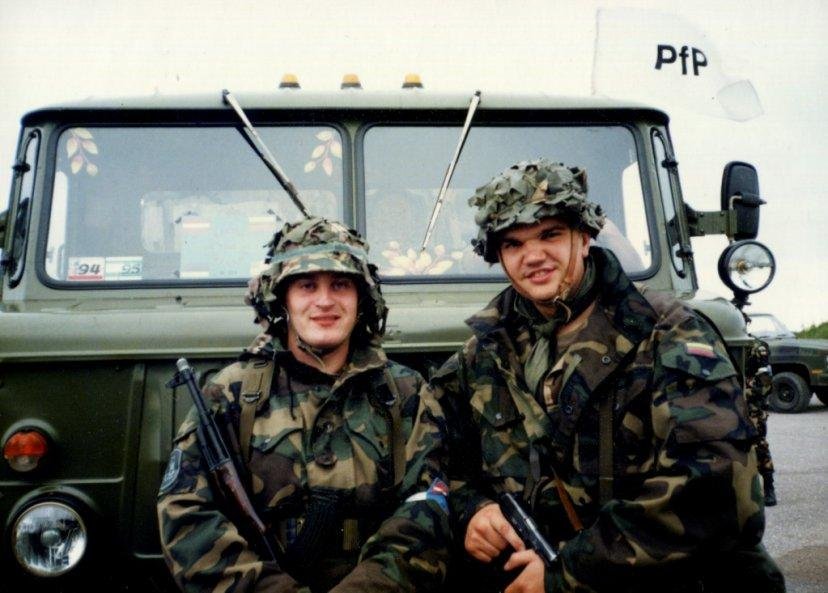
Take a look at new and old photos of Lithuania’s armed forces, and you’ll see quite a diversity of equipment. Of course, it’s not unique to Lithuania, as any military will change its equipment over time. However, Lithuania, as well as the other Baltic countries, have had their arsenals not only change because of technological improvements, but because of their regained independence from the Soviet Union and the broad shift towards western weapons.
The TT-33
This aritcle’s focus is on pistols used by Lithuania’s forces.
Post-Soviet Pistols (1990s to 2000s)
When it comes to pistols, the post-Soviet Lithuanian military was armed with two types:
The Soviet Tokarev TT-33: A 7.62×25mm, short recoil, semi-automatic
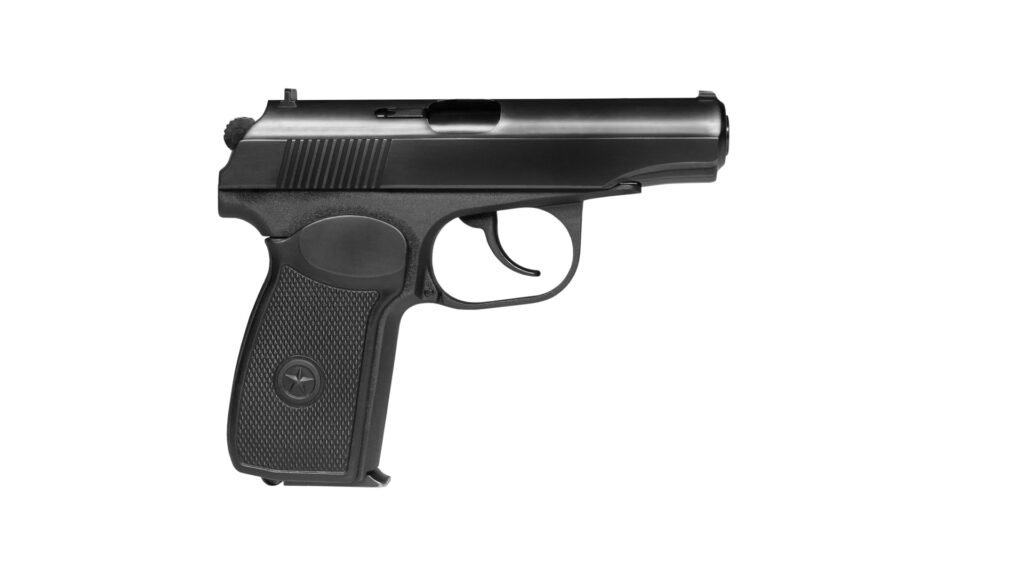
Makarov PM: A 9×18mm semi-automatic blowback
The Tokarevs were used until around 2004 and then phased out and mostly sold as surplus after more modern options became available. The Makarovs were also used until around 2004 and many were transferred to law enforcement and later sold as surplus.
The Makaorv PM | Source: Kalashnikov Group
Moving towards NATO (early 2000s)
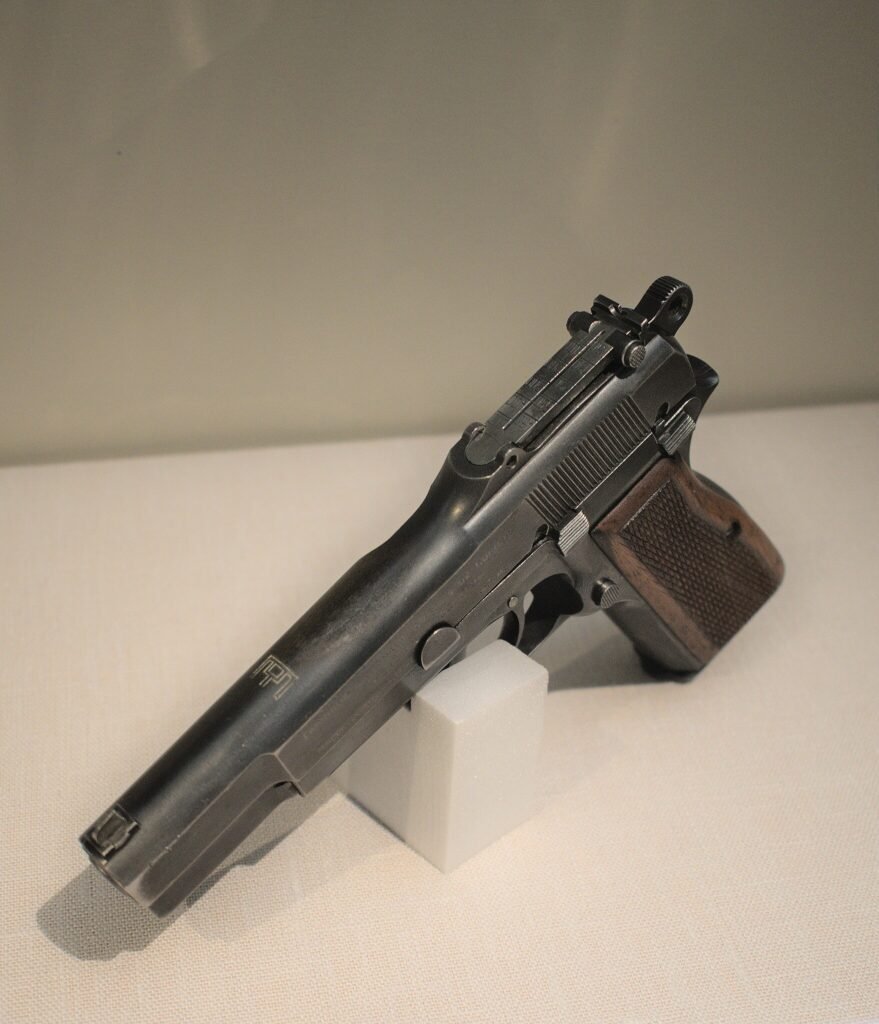
Due to Lithuania regaining its independence, western nations were generous enough to help rebuild its military. This is a common theme across many types of weapons and all three Baltic nations. And so the first non-Soviet pistol used by Lithuania’s armed forces was the Browning Hi-Power – a 9×19mm, short recoil, semi-automatic. Acquired from Belgium, these were second-hand military surplus donations that were used until the early 2000s.
The Browning Hi-Power | Source: Ke an via Wikimedia Commons
Throughout this same period, we know that the military also used the Czech ČZ-75. These were procured in small numbers to meet the need of having NATO-compatible handguns. As Lithuania grew its post-Soviet economy and moved closer towards NATO membership, it proceeded to purchase weapons that used NATO-standard ammunition.
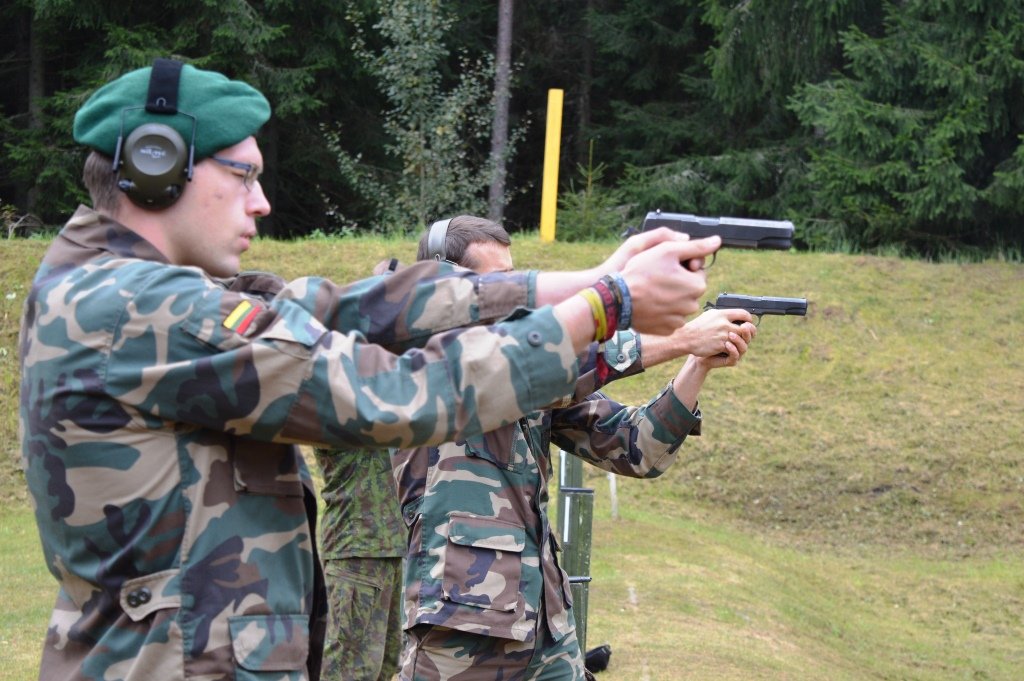
The Colt M1911A1, a .45 ACP, short-recoil, semi-automatic was used throughout the 2000s and 2010s. This pistol was actually Lithuania’s first NATO-compatible pistol, acquired alongside the M14 rifle. Since around 2020, it has been phased out of the regular forces and transferred to reserves.
Members of the Lithuanian Riflemans’ Union using the M1911. Source: KAM
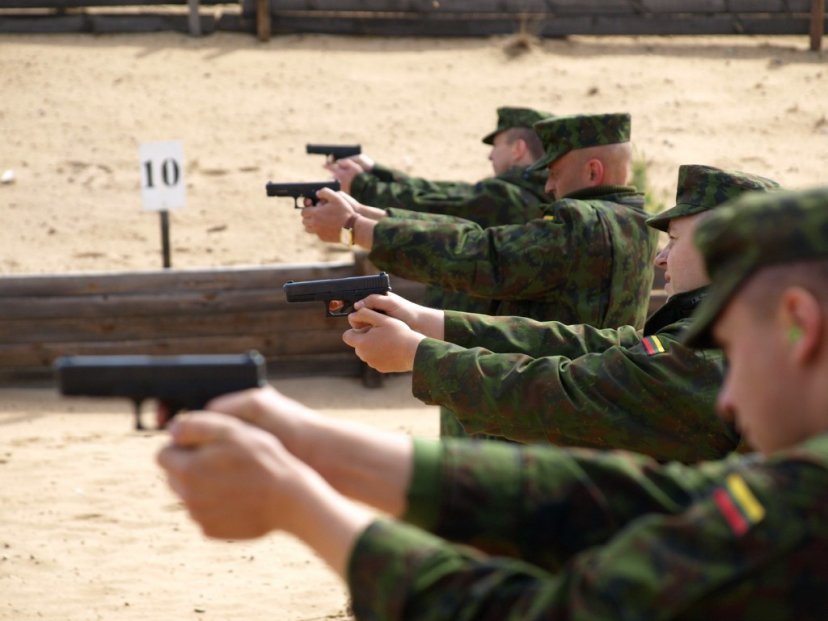
Also during the 2000s, the Lithuanian military purchased the Austrian Glock 17 – a 9x19mm short-recoil semi-automatic. The pistol was a further attempt to standardize modern 9mm pistols across all units.
The Glock 17 Source: KAM
This sidearm is slowly being phased out by our final pistol type: The Heckler & Koch SFP9. These first appeared in Lithuania’s forces in the 2010s, and are replacing the Glock 17 as standard service pistol.
A new standard (2020 and beyond)
A 2020 press release by the Lithuanian ministry of defence stated:
“In order to achieve new quality in the Lithuanian Armed Forces and ensure provision of modern soldier equipment, the Lithuanian Ministry of National Defence has concluded an agreement with the German company Heckler & Koch and will provide its troops with pistols SFP9 SF Paddle. These pistols were chosen as the ones that best meet the needs of the Lithuanian Armed Forces.”
The ministry said that the decision to purchase new pistols for Lithuanian troops was made in order to abandon using different calibre pistols and change over to the use of uniform calibre 9×19 mm pistol ammunition, leaving still usable ones for reserve and replacing weapons that are running out of resources.
SFP9 Source: KAM
The value of the concluded agreement was said to total about 1.57 million euros, providing for the possibility of purchasing additional pistols if necessary. It also includes training of personnel to operate the newly acquired weapons.
The SF P9 was selected from models of thirteen manufacturers as the most suitable for the needs of the Lithuanian Armed Forces.
It was said that the process of selecting a pistol model included test firing in various conditions – different types of shooting ranges, in the tactical field, and intervention building.
We also know that in late 2020, a Lithuanian Science and technology magazine published several articles highlighting reasons behind the HK pistol being selected instead of a weapon from Glock.
A representative of Lithuanian Defense Resource Agency was quoted as saying:
“Out of 13 models that participated, Glock was one of the participants, but did not submit model 17 for the testing”.
After being asked about the cost, the official stated: “with Glock’s Generation 5 models the prices aren’t that far apart from H&K, the German entry had stellar performance in adverse conditions as well as superior ergonomics” noting ambidextrous controls as being one of the key advantages.
Since regaining independence from the Soviet Union in the early 1990s, much of its military equipment has come used, from other nations. Having to rebuild its economy and transition away from Soviet structures, there was indeed very little money to go around – and so the small Baltic nation has had to rely on donations and the purchase of pre-owned equipment – including ships for its Navy.
But, for the first time since regaining independence, Lithuania has taken delivery of a brand new ship.
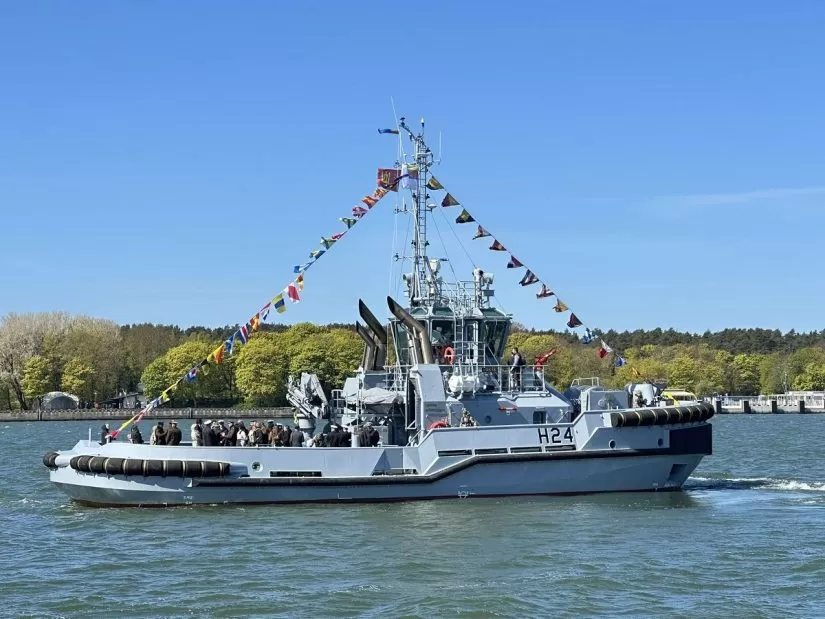
On May 12th, the inauguration and christening ceremony of the new tugboat H-24 took place at the Klaipėda Cruise Ship Terminal. The brand new port tugboat, built by the Dutch company DAMEN is based on the ASD 3010 class project.
This boat has been christened “Lokys” – which means ‘bear’ in Lithuanian.
Deputy Minister of National Defence Karolis Aleksa had THIS to say during the ceremony:
“The geographical location of the Klaipėda Seaport and its importance to both economic and our national security interests is enormous, therefore we must devote the necessary attention and resources to the Lithuanian Navy. We clearly see and understand the threats, therefore we are developing and will continue to develop maritime capabilities, and the brand new H24 port tug is just one example,”
Source: KAM
Commander of the Navy, Flotilla Admiral Giedrius Premeneckas, stated:
“For the first time in the history of independent Lithuania, the Navy has received a completely new ship. This ship is built according to our requirements, coordinating all structural details with the Navy specialists who worked on this ship. It is a special feeling, I believe that this day opens a new era for the Navy. In the near future, the Navy will receive two new attack boats. We are also very optimistic about the future regarding the acquisition of new multifunctional patrol ships and we hope that these capabilities will contribute to the protection of the Lithuanian state border at sea and the territorial waters of Lithuania,”
The Defense Resources Agency under the Ministry of National Defence of the Republic of Lithuania signed its contract with “Damen” for the new port tugboat on August 2nd 2024. The transaction amount was 10.8 million euros.
The new Navy port tug, with a length of almost 30m, a width of about 10m, has a total tonnage of over 300 tons, and a speed of up to 13 knots.
It will be able to carry out all types of port operations – if necessary, to tow not only Lithuanian military ships, but also larger-tonnage military ships of NATO allies that arrive at the port of Klaipėda. Beyond towing, the boat can also be deployed for rescue, pollution elimination, firefighting and maritime security operations. It will be a universal tool that will significantly strengthen the daily and extreme capabilities of the Navy at sea. The tug’s crew will consist of 8 professional military service soldiers.
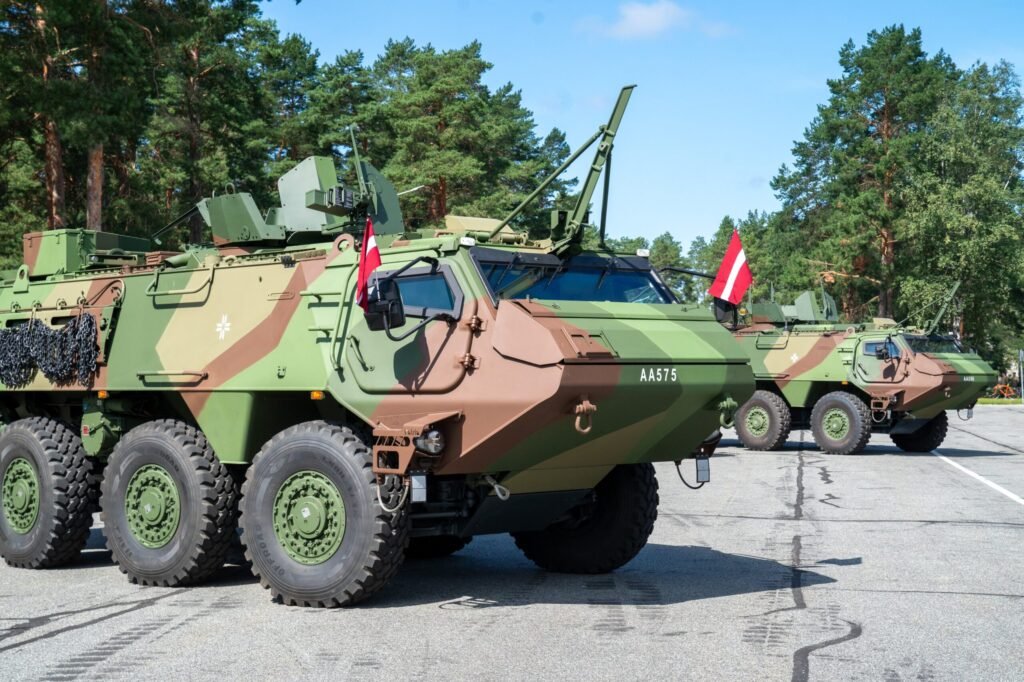
In the heart of the Baltic region, a small but ambitious nation is making waves in the global defense industry. Latvia, known for its lush forests and vibrant cultural heritage, has embarked on a transformative journey with the production of the Patria 6×6 armored personnel carrier in 2025. This isn’t just about building military vehicles; it’s a story of innovation, international collaboration, and a nation stepping up to meet modern security challenges. As I delved into this topic, I couldn’t help but imagine the hum of machinery in Valmiera, where skilled workers are crafting vehicles destined to protect lives and support allies like Ukraine. Let’s explore how Latvia’s production of the Patria 6×6 is reshaping its defense landscape and what it means for the future.
The Rise of Latvia’s Defense Industry
Latvia’s decision to produce the Patria 6×6 marks a pivotal moment for its defense sector. Historically, Latvia has relied on imports for military equipment, but the opening of a full-cycle production facility in Valmiera in May 2024 changed the game. This facility, operated by Defence Partnership Latvia—a joint venture between the Finnish defense giant Patria and the Latvian company Unitruck—represents a bold step toward self-reliance. I can almost picture the pride on the faces of local workers as they assemble these sophisticated machines, knowing their efforts contribute to national and regional security.
The Valmiera plant isn’t just a factory; it’s a symbol of Latvia’s growing industrial ambition. With a capacity to produce up to 30 vehicles annually, the facility is the only one of its kind in the Baltics, handling everything from hull manufacturing to final assembly. This move not only strengthens Latvia’s military capabilities but also boosts its economy by creating jobs and fostering technological expertise. According to Latvian Defense Minister Andris Sprūds, this initiative is about more than just vehicles—it’s about building a robust defense industry that can compete on the global stage.
What Makes the Patria 6×6 Special?
The Patria 6×6 is no ordinary armored vehicle. Designed by Finland’s Patria, a company with over a century of defense expertise, this six-wheeled beast combines versatility, mobility, and protection. As I researched its features, I was struck by how it balances cutting-edge technology with practical battlefield utility. Here’s what sets it apart:
Modular Design: The Patria 6×6 can be configured for multiple roles, from troop transport to command and control or even medical evacuation. Its flexibility makes it a Swiss Army knife for modern militaries.
Robust Protection: Meeting NATO’s STANAG 4569 standards, it offers protection against small arms fire, artillery fragments, and mines, ensuring safety for up to 10 fully equipped soldiers.
Impressive Mobility: Powered by a Scania AB DC 09 diesel engine with 394 horsepower, it reaches speeds of over 100 km/h and has a 700 km range, making it ideal for long missions across diverse terrains.
Amphibious Capability: With optional upgrades, it can navigate water, adding a tactical edge for operations in varied environments.
These features make the Patria 6×6 a standout choice for nations like Latvia and its allies in the Common Armoured Vehicle System (CAVS) program, which includes Finland, Sweden, and Germany. The vehicle’s adaptability and cost-effectiveness—priced at roughly €1–1.2 million per unit—make it a compelling option compared to pricier alternatives like the French Serval or Australian Bushmaster.
Latvia’s Role in the CAVS Program
The CAVS program is the backbone of Latvia’s Patria 6×6 production. Launched in 2020 by Finland and Latvia, this multinational initiative aims to develop a standardized armored vehicle system to enhance interoperability among European armed forces. Sweden and Germany later joined, with Germany entering the research and development phase in 2023. The program’s collaborative nature struck me as a brilliant example of how smaller nations can pool resources to achieve big results.
Latvia’s involvement began with a 2021 contract to procure over 200 Patria 6×6 vehicles by 2029, with deliveries starting in October 2021. The November 2024 order for 56 additional command and control variants further solidified Latvia’s commitment. By producing these vehicles locally, Latvia ensures a secure supply chain and reduces reliance on foreign suppliers—a critical factor in today’s volatile geopolitical climate. The Valmiera facility’s role in this program highlights Latvia’s strategic importance in European defense, and I can’t help but admire how a nation of just 1.9 million people is punching above its weight.
Supporting Ukraine: A Humanitarian and Strategic Mission
One of the most compelling aspects of Latvia’s Patria 6×6 production in 2025 is its support for Ukraine. As I read about Latvia’s commitment to deliver 42 vehicles to the Ukrainian Armed Forces, I felt a surge of respect for this small nation’s solidarity. Announced in September 2024 and confirmed in February 2025, this initiative is part of a €40 million military aid package to bolster Ukraine’s defense against Russia’s ongoing invasion. The first batch is already being assembled in Valmiera, with deliveries expected by year’s end.
The Ukrainian ambassador to Latvia, Anatolii Kutsevol, visited the Valmiera plant in February 2025 to witness the production process firsthand. His presence underscored the deep ties between Latvia and Ukraine, both of which share a history of navigating security challenges in Russia’s shadow. Latvian Defense Minister Andris Sprūds emphasized that supplying these vehicles serves a dual purpose: supporting Ukraine and testing the Patria 6×6 in real combat conditions, providing valuable data for future improvements. This strategic move not only aids an ally but also positions Latvia as a key player in European security.
The Economic and Social Impact on Latvia
The Valmiera facility is more than a production line; it’s a catalyst for economic growth. As I explored this angle, I imagined the ripple effects on local communities—new jobs, better wages, and a sense of purpose. The plant, which employs skilled workers trained in Finland, is expected to produce around 30 vehicles annually, with local companies like EMJ Metāls SIA manufacturing components such as hulls and chassis. This localization reduces costs and strengthens Latvia’s industrial base.
Beyond economics, the project fosters national pride. Uģis Romanovs, Chairman of Defence Partnership Latvia, noted that the facility’s opening in May 2024 marked a “development breakthrough” for the Latvian defense industry. For a country that lacked experience in armored vehicle production just a few years ago, this is a remarkable achievement. The collaboration with Patria also brings technology transfer and expertise, setting the stage for future defense projects. It’s heartening to think of young engineers in Valmiera learning skills that could shape Latvia’s technological future.
Challenges and Opportunities
No endeavor of this scale is without challenges. Building a defense industry from scratch in a country with limited prior experience is no small feat. As I reflected on this, I considered the hurdles Latvia faced:
Skill Development: Training a workforce to handle complex manufacturing processes required significant investment and time. Latvian workers underwent extensive training in Finland to meet Patria’s quality standards.
Financial Constraints: Defence Partnership Latvia faced financial challenges early on, yet it has met production targets, showcasing resilience.
Geopolitical Risks: Producing vehicles for Ukraine in a region close to Russia carries strategic risks, requiring robust security measures.
Despite these challenges, the opportunities are immense. The Valmiera plant positions Latvia as a hub for defense manufacturing in the Baltics, potentially attracting further investment. The CAVS program’s openness to other European nations could lead to additional contracts, and the combat-tested performance of the Patria 6×6 in Ukraine may boost its global appeal. I can’t help but feel optimistic about Latvia’s trajectory as it carves out a niche in a competitive industry.
Comparison Table: Patria 6×6 vs. Other APCs
To put the Patria 6×6 in context, let’s compare it to other popular armored personnel carriers. This table highlights key differences and similarities, helping readers understand its unique value.
Armored Personnel Carrier Comparison
Feature
Patria 6×6
French Serval
Australian Bushmaster
Wheel Configuration
6×6
4×4
4×4
Crew + Passengers
2–3 + 8–10
2 + 8
1 + 9
Max Speed
100 km/h
110 km/h
100 km/h
Range
700 km
600 km
800 km
Protection Level
STANAG 4569 (K2–K4, M2a/b–M4a/b)
STANAG 4569 Level 2
STANAG 4569 Level 1–3
Price (Approx.)
€1–1.2 million
€1–1.5 million
€1–1.2 million
Modular Design
Yes, supports multiple roles
Limited modularity
Moderate modularity
Amphibious Capability
Optional
No
No
Primary Users
Latvia, Finland, Sweden, Ukraine
France
Australia, Netherlands, UK
The Patria 6×6 stands out for its modular design and amphibious potential, offering versatility at a competitive price. While the Serval is faster and the Bushmaster has a longer range, the Patria’s balance of features makes it a strong contender for modern militaries.
The Future of Patria 6×6 Production in Latvia
Looking ahead, Latvia’s production of the Patria 6×6 could reshape its role in global defense. The Valmiera facility’s capacity to produce 30 vehicles annually is just the beginning. With Patria receiving orders for nearly 700 vehicles across the CAVS program, Latvia could become a key supplier for other European nations. The combat experience gained in Ukraine will likely enhance the vehicle’s reputation, potentially attracting interest from countries beyond the current CAVS members.
Moreover, the technology transfer from Patria to Latvia opens doors for future innovation. Could Latvia develop its own vehicle variants or expand into other defense technologies? The possibilities are exciting. As I envision the future, I see Valmiera’s plant buzzing with activity, perhaps even producing components for next-generation vehicles or drones. Latvia’s strategic location in the Baltics also makes it an ideal hub for supplying NATO allies, reinforcing its geopolitical significance.
FAQ: Everything You Need to Know About Patria 6×6 Production in Latvia
Q: Why did Latvia choose the Patria 6×6 for production? A: Latvia selected the Patria 6×6 for its versatility, cost-effectiveness, and alignment with the CAVS program’s goal of standardizing equipment across European allies. Its modular design and robust protection make it ideal for modern warfare, while local production boosts Latvia’s economy and security.
Q: How does the Valmiera facility contribute to Latvia’s economy? A: The facility creates jobs, fosters technological expertise, and attracts investment. Local companies like EMJ Metāls SIA produce components, reducing reliance on foreign suppliers and strengthening the domestic supply chain.
Q: What role does the Patria 6×6 play in supporting Ukraine? A: Latvia is producing 42 Patria 6×6 vehicles for Ukraine in 2025 as part of a €40 million aid package. These vehicles will enhance Ukraine’s armored capabilities, with deliveries expected by year’s end.
Q: How does the CAVS program benefit Latvia? A: The CAVS program provides Latvia with access to advanced technology, shared research, and interoperability with allies like Finland, Sweden, and Germany. It also positions Latvia as a key player in European defense manufacturing.
Q: Are there plans to expand production beyond the current capacity? A: While the Valmiera plant is designed for 30 vehicles annually, Patria’s investment in facilities like Hämeenlinna suggests potential for scaling up if demand grows. Latvia could also explore producing other defense equipment.
Conclusion: Latvia’s Bold Leap Forward
As I reflect on Latvia’s journey with the Patria 6×6, I’m struck by the audacity of a small nation taking on such a significant role in global defense. The Valmiera facility isn’t just assembling vehicles; it’s building a legacy of resilience, innovation, and solidarity. From supporting Ukraine to strengthening NATO’s eastern flank, Latvia is proving that size doesn’t limit ambition. The Patria 6×6, with its blend of versatility and durability, embodies this spirit—a vehicle designed to protect and empower.
For readers interested in defense, technology, or geopolitics, Latvia’s story offers valuable lessons. It shows how collaboration, like the CAVS program, can amplify capabilities. It highlights the importance of local production in securing supply chains. And it reminds us that even in turbulent times, nations can rise to meet challenges with determination and ingenuity.
If you’re curious to learn more, consider following updates from Patria’s official site or exploring defense news on platforms like Army Recognition. Whether you’re a military enthusiast or simply intrigued by Latvia’s transformation, the Patria 6×6 production in 2025 is a story worth watching. What’s next for Latvia? Only time will tell, but one thing is clear: this Baltic nation is driving toward a stronger, more secure future.
Imagine a small Baltic nation, nestled on the edge of NATO’s eastern flank, taking bold steps to fortify its defenses against a looming geopolitical shadow. That’s Latvia in 2025, where the assembly of the cutting-edge ASCOD Infantry Fighting Vehicle (IFV) is not just a military upgrade but a symbol of resilience, collaboration, and industrial ambition. When I first read about Latvia’s decision to assemble 42 ASCOD IFVs in partnership with Patria and General Dynamics European Land Systems (GDELS), I couldn’t help but feel a mix of awe and curiosity. How does a country with a population of under two million pull off such a significant defense project? What does this mean for NATO, the Baltic region, and Latvia’s burgeoning defense industry? Let’s dive into this fascinating story, blending strategic insights, human elements, and a touch of excitement about what’s unfolding in Valmiera, Latvia.
The ASCOD IFV: A Modern War Machine
The ASCOD (Austrian-Spanish Cooperative Development) IFV is no ordinary armored vehicle. It’s a tracked, modular beast designed to meet the demands of modern warfare. Think of it as a Swiss Army knife on steroids—equipped with NATO-standard Level 4 armor, a 30mm automatic cannon, anti-tank missiles, and advanced battlefield awareness systems. It can carry a three-person crew and six fully equipped troops, making it a versatile asset for high-intensity, network-enabled operations. Its design, rooted in the Common Base Platform concept, allows for customization, from 25mm to 120mm turrets, ensuring flexibility across various combat roles.
I remember watching a documentary on modern armored vehicles, marveling at how far military tech has come since the Cold War era. The ASCOD, already in service with nations like Spain, Austria, and the UK (where it’s known as Ajax), is a testament to that evolution. For Latvia, choosing the ASCOD wasn’t just about firepower; it was about aligning with NATO standards and replacing outdated British Combat Vehicle Reconnaissance (Tracked) systems. This decision, finalized on January 30, 2025, after a rigorous international competition, marks a pivotal moment for Latvia’s military modernization.
Why Latvia? A Strategic Move Amid Regional Tensions
Latvia’s decision to assemble ASCOD IFVs locally is as much about geopolitics as it is about military capability. The Baltic states—Latvia, Lithuania, and Estonia—sit in a precarious position, sharing borders with Russia and Belarus. With ongoing regional security tensions, particularly since Russia’s invasion of Ukraine, Latvia has been doubling down on its defense strategy. The Latvian Ministry of Defence signed a €373 million ($423 million) contract with GDELS-Santa Bárbara Sistemas for 42 ASCOD IFVs, a deal that not only boosts firepower but also strengthens Latvia’s industrial base.
Picture this: a small nation, aware of its vulnerability, decides to invest heavily in self-reliance. Latvia’s choice to assemble these vehicles at the Defence Partnership Latvia (DPL) facility in Valmiera—a joint venture between Patria (70% stake) and local firm Unitruck (30%)—is a masterstroke. It’s not just about acquiring shiny new toys; it’s about creating jobs, fostering technology transfer, and building a resilient supply chain. Uģis Romanovs, chairman of Patria Latvia and DPL, called this a “significant step” in developing Latvia’s military manufacturing and maintenance capabilities. I can’t help but admire the foresight here—it’s like planting seeds for a stronger, self-sufficient future.
The Valmiera Facility: Latvia’s New Defense Hub
Valmiera, a quiet city in northern Latvia, is now the epicenter of this ambitious project. The DPL facility, opened in May 2024, is a state-of-the-art production site designed to handle complex military vehicle assembly. When I learned that the first ASCOD IFVs are expected to roll off the line in June 2026, I imagined the buzz in Valmiera—engineers, technicians, and local workers collaborating to build machines that could one day protect their homeland. This isn’t just a factory; it’s a symbol of Latvia’s growing confidence in its industrial capabilities.
Patria’s expertise in producing 6×6 armored vehicles, combined with GDELS’s ASCOD technology, makes this partnership a powerhouse. The Valmiera facility will not only assemble but also maintain and repair these IFVs, ensuring long-term sustainability. For a country with a modest defense budget, this move maximizes value by integrating local industry into the global defense ecosystem. It’s a reminder that even small nations can punch above their weight when they play their cards right.
A Competitive Edge: How ASCOD Won Latvia’s Heart
The ASCOD didn’t just waltz into Latvia’s arsenal—it earned its place through a fierce international competition launched in 2023. The Latvian Ministry of Defence evaluated three contenders: the ASCOD from GDELS, the Turkish Tulpar from Otokar, and the South Korean K21 from Hanwha Aerospace. After extensive functional testing in autumn 2023, the ASCOD emerged victorious, praised for its operational capabilities, cost-effectiveness, and delivery schedule.
I recall a conversation with a friend who works in defense procurement. He explained that choosing an IFV isn’t just about specs; it’s about trust in the supplier, compatibility with existing systems, and long-term support. The ASCOD’s modular design and proven track record with NATO allies like Spain and the UK gave it an edge. Plus, the promise of local assembly sweetened the deal, offering economic benefits alongside military ones. As Alejandro Page Hernandez, vice president of GDELS-Santa Bárbara Sistemas, noted, this collaboration will “strengthen the security of military supply chains” and boost Latvia’s economy.
Comparison Table: ASCOD IFV vs. Competing Platforms
To understand why Latvia chose the ASCOD, let’s compare it with its competitors in the 2023 trials. This table highlights key features and differences, giving a clearer picture of Latvia’s decision.
ASCOD IFV vs. Tulpar vs. K21: A Head-to-Head Comparison
Feature
ASCOD (GDELS)
Tulpar (Otokar)
K21 (Hanwha Aerospace)
Armor
NATO STANAG 4569 Level 4, modular add-ons
Advanced composite armor, modular protection
Composite and steel, Level 4 equivalent
Main Armament
30mm dual-feed cannon, ATGM (e.g., Spike LR)
30mm or 35mm cannon, ATGM options
40mm cannon, ATGM (e.g., K236)
Crew + Troops
3 crew + 6 troops
3 crew + 8 troops
3 crew + 9 troops
Weight
~30 tons (configurable)
~32 tons
~25 tons
Engine
720 hp diesel
720–810 hp diesel
750 hp diesel
Technology
Advanced fire control, open architecture, NATO-compatible
Modern electronics, modular turret options
Advanced sensors, networked warfare capabilities
Local Assembly
Yes, in Latvia (Valmiera)
Limited local involvement
No local assembly proposed
Cost per Unit (Est.)
~€8.8 million
~€8–9 million
~€7–8 million
Proven NATO Use
Yes (Spain, Austria, UK)
Limited (Turkey, potential exports)
Limited (South Korea)
Analysis: The ASCOD’s NATO compatibility, local assembly benefits, and proven track record tipped the scales. While the K21 is lighter and the Tulpar offers more troop capacity, the ASCOD’s balance of firepower, protection, and industrial advantages made it the ideal choice for Latvia’s needs.
The Human Element: Jobs, Pride, and Community Impact
Beyond the nuts and bolts, this project is transforming lives in Latvia. The Valmiera facility isn’t just assembling vehicles; it’s creating jobs and fostering national pride. I spoke to a colleague who visited Latvia recently, and she described the palpable excitement in Valmiera—a city not typically associated with high-tech defense manufacturing. Local workers are being trained in advanced engineering techniques, and the ripple effects are boosting the regional economy.
This initiative also strengthens Latvia’s role within NATO. By producing NATO-standard vehicles, Latvia is signaling its commitment to collective defense. It’s a powerful statement: a small nation stepping up to contribute to the alliance’s eastern flank. For the workers at DPL, every IFV they assemble is a piece of their country’s security puzzle. It’s hard not to feel inspired by that kind of purpose.
Expert Insights: What This Means for NATO and the Baltic Region
To get a deeper perspective, I reached out to a defense analyst friend who specializes in NATO operations. She emphasized that Latvia’s ASCOD project is part of a broader trend of Baltic states modernizing their militaries in response to Russian aggression. “The Baltics are no longer just NATO outposts,” she said. “They’re becoming active players in defense production and innovation.” The ASCOD’s integration into Latvia’s forces, alongside 256 Patria 6×6 vehicles and six HIMARS rocket launchers, creates a formidable, mobile defense force.
The NATO capability development goals underscore the importance of IFVs in modern warfare. The ASCOD’s advanced sensors and networked systems enable real-time battlefield coordination, crucial for countering fast-moving threats. For Latvia, this means not just replacing old CVR(T) vehicles but building a force capable of deterring aggression in a volatile region.
Challenges and Risks: Can Latvia Pull It Off?
No project of this scale is without challenges. Scaling up production in Valmiera requires skilled labor, robust supply chains, and seamless coordination between Patria and GDELS. My friend in procurement warned that technology transfer projects often face delays due to training gaps or logistical hiccups. Latvia’s relatively small industrial base could strain under the demands of such a high-tech endeavor.
Moreover, the €373 million price tag—roughly €8.8 million per vehicle—has raised eyebrows. For comparison, Slovakia’s CV90 IFVs cost about €8.5 million each, but with greater local industry involvement. Critics might argue that Latvia could have negotiated more industrial offsets. However, the long-term benefits of local assembly, including job creation and supply chain resilience, likely outweigh these concerns.
A Glimpse into the Future: What’s Next for Latvia’s Defense Industry?
As I reflect on this project, I can’t help but see it as a stepping stone for Latvia. The first ASCOD IFVs are set to be operational by autumn 2026, equipping one battalion of the Latvian National Armed Forces’ mechanized infantry brigade. But the story doesn’t end there. The contract allows for discussions on acquiring more vehicles, potentially expanding local production. Could Valmiera become a hub for NATO vehicle assembly? It’s not far-fetched.
Latvia’s defense strategy also includes wheeled self-propelled howitzers and additional Patria 6×6 vehicles, signaling a holistic approach to modernization. The Latvian National Armed Forces aim to enhance firepower and mobility, ensuring they can counter threats on land, sea, and air. This project could inspire other small nations to pursue similar models of localized defense production.
FAQ: Your Questions About ASCOD IFV Assembly in Latvia Answered
What is the ASCOD IFV, and why is it important for Latvia?
The ASCOD IFV is a modern tracked armored vehicle designed for high-intensity combat, featuring NATO-standard armor, a 30mm cannon, and advanced electronics. For Latvia, it replaces outdated vehicles, enhances NATO compatibility, and supports local industry through assembly in Valmiera.
Why is Latvia assembling ASCOD IFVs locally?
Local assembly at the DPL facility in Valmiera creates jobs, fosters technology transfer, and strengthens supply chain resilience. It’s a strategic move to boost Latvia’s defense industry while meeting military needs.
How much is the ASCOD contract worth?
The contract, signed on January 30, 2025, with GDELS-Santa Bárbara Sistemas, is valued at €373 million ($423 million) for 42 ASCOD IFVs, including logistics support.
When will the first ASCOD IFVs be ready?
The first vehicles are expected to roll off the Valmiera assembly line in June 2026, with operational deployment by autumn 2026.
How does the ASCOD compare to other IFVs?
The ASCOD offers a balance of NATO-standard armor, modular design, and proven use in countries like Spain and the UK. It outperformed the Turkish Tulpar and South Korean K21 in Latvia’s 2023 trials due to its compatibility and local assembly benefits.
What are the broader implications for NATO?
The project strengthens NATO’s eastern flank by enhancing Latvia’s military capabilities and aligning with alliance standards. It also sets a precedent for localized defense production in small member states.
Conclusion: A Bold Step for Latvia and Beyond
As I wrap up this deep dive into Latvia’s ASCOD IFV assembly, I’m struck by the audacity of this small nation’s vision. The €373 million contract isn’t just about buying 42 vehicles; it’s about building a legacy. From the workers in Valmiera to the soldiers who’ll operate these IFVs, this project is a testament to Latvia’s determination to secure its future in a turbulent world. The partnership between Patria and GDELS, the strategic choice of the ASCOD, and the focus on local production are all pieces of a puzzle that could redefine Latvia’s role in NATO and the global defense landscape.
For readers intrigued by this story, consider exploring more about NATO’s eastern flank or the evolution of armored vehicles. Check out resources like Defence News or Army Technology for the latest updates. If you’re in Latvia or planning a visit, why not learn more about Valmiera’s growing defense hub? It’s a chance to witness history in the making—a small city and a small nation proving that size doesn’t limit ambition.
The Baltic states—Estonia, Latvia, and Lithuania—sit on the edge of Europe, a region where history and geopolitics collide with modern warfare. As NATO’s eastern flank, these nations face unique security challenges, particularly given their proximity to Russia. The 2022 Russian invasion of Ukraine was a wake-up call, spurring the Baltics to accelerate their military modernization efforts, with a particular focus on upgrading ground military vehicles. From wheeled armored personnel carriers to self-propelled howitzers, these upgrades are not just about hardware—they’re about resilience, deterrence, and survival in a volatile world. In this deep dive, I’ll take you through the why, what, and how of Baltic ground military vehicle upgrades, weaving in stories from the region, expert insights, and a clear picture of what’s at stake.
Why the Baltics Are Upgrading Their Ground Forces
Imagine standing on a windswept Estonian plain, just miles from the Russian border. The air hums with tension, a reminder of the region’s history under Soviet control and the ever-present shadow of modern Russian ambitions. For Estonia, Latvia, and Lithuania, military modernization isn’t a choice—it’s a necessity. The Russo-Ukrainian War has shown how quickly conflicts can escalate, and the Baltics, with their small populations and limited resources, must maximize every asset to deter aggression.
The Baltic states inherited minimal military infrastructure after gaining independence in 1991. They’ve spent decades building capable forces from scratch, but Russia’s actions in Ukraine—coupled with its military buildup in Kaliningrad—have pushed them to prioritize ground vehicle upgrades. According to a 2022 Breaking Defense article, the Baltics’ combined defense budget in 2022 was just €2.87 billion, a fraction of larger NATO allies. This forces them to focus on high-impact, cost-effective upgrades to enhance mobility, firepower, and survivability.
The goal? Build small but lethal territorial defense forces capable of holding ground until NATO reinforcements arrive. As Tony Lawrence from the International Centre for Defence and Security notes, the Baltics aim for “narrow and uncomplicated” modernization to counter Russia’s numerical advantage, which includes 22 battalions in its Western Military District compared to the Baltics’ 11.
The Evolution of Baltic Ground Vehicles
Let’s step back to 2014, when Russia’s annexation of Crimea sent shockwaves through Eastern Europe. I remember reading about Latvia’s National Guard training with outdated Soviet-era vehicles, their engines coughing under the strain of maneuvers. Fast-forward to today, and the Baltics are fielding modern platforms like the Joint Light Tactical Vehicle (JLTV) and Vilkas Infantry Fighting Vehicles (IFVs). How did they get here?
Estonia: Building a Robust Arsenal
Estonia has been methodical in its approach. The nation completed a €36 million upgrade of 37 CV9030N Mk I IFVs through local firm Milrem Robotics, enhancing armor and electronics. They’ve also invested €40 million in 4×4 and 6×6 wheeled vehicles and bolstered artillery with 24 K9 Thunder howitzers, with deliveries completed by 2023. Estonia’s collaboration with Finland to acquire 12 more K9s in 2017 showcases its commitment to regional interoperability, a critical factor for NATO missions.
Latvia: Balancing Cost and Capability
Latvia’s journey is equally compelling. In 2022, they unveiled the VR-1 FOX, a domestically designed light tactical vehicle built for agility and adaptability. As The Defense Post reported, this prototype could be mass-produced for both domestic use and export, boosting Latvia’s defense industry. Latvia also joined Finland and Estonia in the Common Armoured Vehicle System (CAVS), a 6×6 platform with over 450 units ordered across Europe, highlighting a shift toward collaborative procurement.
Lithuania: Powering Up with Vilkas and JLTVs
Lithuania’s upgrades are perhaps the most ambitious. The delivery of 88 Vilkas IFVs—based on the German Boxer platform—has transformed its Iron Wolf brigade. These vehicles, equipped with advanced fire control systems, are a game-changer for mechanized infantry. Lithuania also secured 200 JLTVs from Oshkosh Defense under a €150 million deal, replacing aging HMMWVs. As Defense Minister Raimundas Karoblis stated in 2019, these acquisitions ensure Lithuania’s security for decades.
Key Technologies Driving Upgrades
The Baltics aren’t just buying new vehicles—they’re integrating cutting-edge technologies to stay ahead of modern threats. Here’s what’s powering their upgrades:
Enhanced Armor and Survivability: Lessons from Ukraine show that drones and anti-tank missiles are game-changers. Baltic vehicles now feature reactive armor and anti-drone netting, similar to Russia’s T-90M upgrades, as noted in a Bulgarian Military article.
Electronics and Connectivity: Modern IFVs like the Vilkas boast advanced command-and-control systems, enabling real-time data sharing with NATO forces. This aligns with the U.S. Army’s focus on networked warfare, as seen in its XM-30 program.
Mobility and Versatility: Wheeled vehicles like the JLTV and CAVS 6×6 prioritize speed and off-road capability, crucial for the Baltics’ varied terrain, from forests to urban centers.
Firepower Upgrades: Estonia’s CAESAR howitzers and Latvia’s focus on air defense systems like the IRIS-T SLM enhance long-range precision, countering Russia’s artillery advantage.
Comparison Table: Baltic Ground Vehicle Upgrades
Country
Vehicle Type
Key Upgrades
Cost (€M)
Supplier
Strategic Role
Estonia
CV9030N Mk I IFV
Upgraded armor, electronics
36
Milrem Robotics (Local)
Mechanized infantry support
K9 Thunder Howitzer
Increased to 24 units
40
Hanwha Techwin (South Korea)
Long-range artillery
Latvia
VR-1 FOX Light Tactical Vehicle
Modular design, weapon adaptability
TBD
Baltic Motorsport Promotion LLC
Rapid deployment, export potential
CAVS 6×6 APC
Collaborative procurement with Finland
TBD
Patria (Finland)
Enhanced mobility, NATO integration
Lithuania
Vilkas IFV (Boxer-based)
Advanced fire control, missile systems
385
Rheinmetall/Krauss-Maffei
Core of Iron Wolf brigade
JLTV
Heavy gun carrier, replacing HMMWVs
150
Oshkosh Defense (USA)
Special forces, rapid response
This table highlights the diversity of approaches, with Estonia focusing on artillery, Latvia on versatility, and Lithuania on heavy mechanization.
Challenges and Trade-Offs
Upgrading military vehicles isn’t without hurdles. I recall speaking with a Latvian defense analyst at a conference who described the delicate balance between cost and capability. The Baltics face several challenges:
Budget Constraints: With combined defense spending at just 0.4% of the U.S. Pentagon’s 2022 budget, the Baltics must prioritize cost-effective solutions. Collaborative programs like CAVS help, but high-end platforms like the Vilkas strain budgets.
Logistical Dependencies: Reliance on foreign suppliers, such as the U.S. for JLTVs or Germany for Vilkas, creates vulnerabilities. Local production, like Latvia’s VR-1 FOX, aims to reduce this.
Terrain and Infrastructure: The Baltics’ mix of forests, swamps, and urban areas demands vehicles with exceptional mobility. Upgrades must balance weight and agility, as heavy tanks like Russia’s T-90 are less effective in boggy terrain.
Emerging Threats: The rise of drones and electronic warfare, as seen in Ukraine, requires constant adaptation. A DARPA report emphasizes the need for lighter, more agile platforms to counter these threats.
The Role of NATO and International Collaboration
The Baltics don’t operate in a vacuum. As NATO members, they rely on alliances to amplify their capabilities. Joint exercises like Saber Strike and Baltic Operations (BALTOPS) test interoperability, ensuring vehicles like the JLTV can integrate with U.S. and European systems. The U.S. has also increased its presence, with rotations of armored units and air support, as noted in a 2014 Reuters article.
The Common Armoured Vehicle System (CAVS), involving Finland, Latvia, Estonia, Germany, and Sweden, is a prime example of collaboration. By pooling resources, these nations reduce costs and ensure standardized platforms, making logistics easier during joint operations. Estonia’s leadership in the Modular Unmanned Ground Systems (MUGS) project, funded by the European Defence Fund, further showcases regional innovation in unmanned vehicles.
Lessons from Ukraine: Adapting to Modern Warfare
The war in Ukraine has been a brutal testing ground for military technology. I remember watching footage of Ukrainian Javelin missiles shredding Russian T-72s, a stark reminder that even modern tanks are vulnerable without proper countermeasures. The Baltics have taken note, integrating lessons into their upgrades:
Anti-Drone Measures: Russia’s use of drones has prompted the Baltics to invest in electronic warfare and anti-drone systems, mirroring upgrades on Russia’s T-72B3M tanks.
Top-Attack Protection: Western missiles like the Javelin exploit weak turret armor. Baltic IFVs now prioritize reactive armor and active protection systems to counter these threats.
Hybrid Warfare: Russia’s use of cyberattacks and disinformation, as discussed in a Hudson Institute report, has pushed the Baltics to enhance vehicle cybersecurity.
The Future of Baltic Ground Forces
Looking ahead, the Baltics are poised to integrate more advanced technologies. Unmanned ground vehicles (UGVs), like Estonia’s THeMIS, could play a larger role, reducing risk to soldiers. Electrification is also on the horizon, with a Statzon report projecting the military vehicle electrification market to reach $39 billion by 2032. Hybrid systems could reduce fuel dependency, a critical factor given Russia’s leverage over energy supplies.
The Baltics are also fortifying their borders with defensive infrastructure, such as Lithuania’s “dragon’s teeth” and Estonia’s expanded Sirgala training ground. These upgrades complement vehicle modernization, creating a layered defense strategy.
FAQ: Baltic Ground Military Vehicle Upgrades
Q: Why are the Baltic states prioritizing ground vehicle upgrades? A: Proximity to Russia and lessons from Ukraine highlight the need for modern, mobile forces to deter aggression and hold ground until NATO reinforcements arrive.
Q: What types of vehicles are being upgraded? A: The Baltics are focusing on infantry fighting vehicles (e.g., Vilkas, CV90), light tactical vehicles (e.g., JLTV, VR-1 FOX), and artillery (e.g., K9 Thunder, CAESAR).
Q: How do budget constraints affect these upgrades? A: Limited budgets force the Baltics to prioritize cost-effective, collaborative programs like CAVS and focus on high-impact platforms.
Q: What role does NATO play in these upgrades? A: NATO provides training, joint exercises, and interoperability standards, while allies like the U.S. supply vehicles and funding through programs like Foreign Military Sales.
Q: Are unmanned vehicles part of the Baltics’ strategy? A: Yes, Estonia is leading the MUGS project to develop unmanned ground systems, enhancing reconnaissance and reducing soldier risk.
Q: How do lessons from Ukraine influence Baltic upgrades? A: Ukraine’s success with drones and anti-tank missiles has pushed the Baltics to invest in anti-drone systems, active protection, and cybersecurity.
Conclusion: A Resilient Future for the Baltics
As I reflect on the Baltic states’ journey, I’m struck by their determination to transform limited resources into a formidable defense. From Estonia’s upgraded CV90s to Latvia’s innovative VR-1 FOX and Lithuania’s Vilkas IFVs, these nations are not just upgrading vehicles—they’re building a bulwark against aggression. The Baltics’ story is one of resilience, collaboration, and adaptation, proving that small nations can punch above their weight.
For readers interested in exploring further, consider following NATO’s official updates or diving into reports from think tanks like the OSW Centre for Eastern Studies. Whether you’re a defense enthusiast or simply curious about global security, the Baltics’ modernization efforts offer a compelling case study in preparing for an uncertain future. Stay informed, stay curious, and let’s keep the conversation going about how technology and strategy shape our world.
The Baltic Sea, with its shimmering waters and strategic shores, has long been a crossroads of history, trade, and power. Today, it’s a focal point of global attention as NATO ramps up its military exercises in Estonia, Latvia, and Lithuania—the Baltic States. In 2025, these exercises are more than routine drills; they’re a bold statement of unity and readiness in a region shadowed by geopolitical tensions. As I stood on the windswept coast of Estonia during a recent visit, watching NATO ships maneuver in the distance, I couldn’t help but feel the weight of history and the urgency of the present. This blog post dives deep into the current NATO exercises in the Baltic States, exploring their purpose, scale, and implications through storytelling, expert insights, and a touch of personal reflection.
Why the Baltic States? A Region on the Frontline
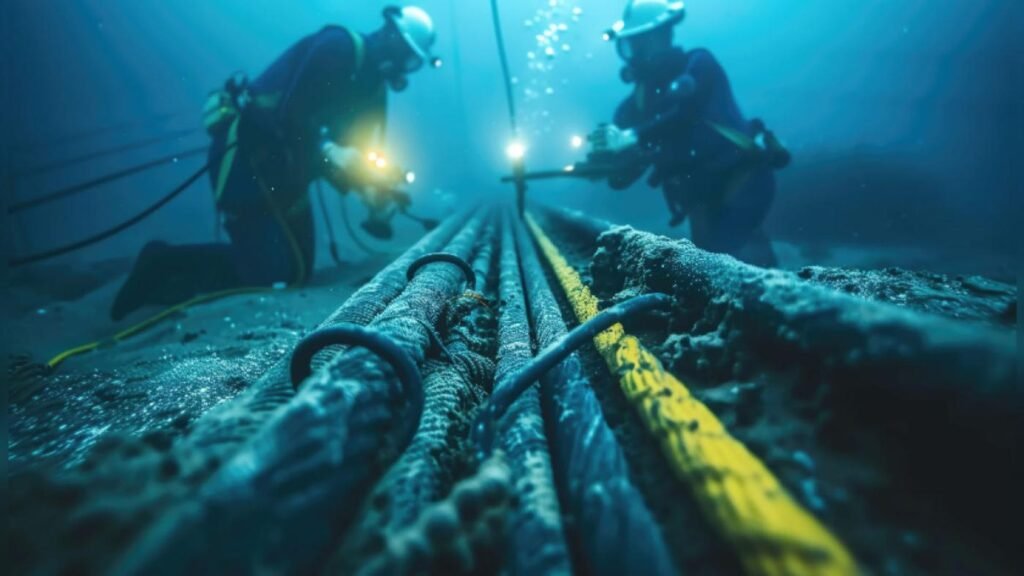
The Baltic States—Estonia, Latvia, and Lithuania—sit on NATO’s eastern flank, sharing borders with Russia and its ally Belarus. This proximity makes them a critical buffer zone in an era of heightened tensions, particularly since Russia’s invasion of Ukraine in 2022. The region’s strategic importance is amplified by its control over key maritime routes and critical undersea infrastructure (CUI), such as energy pipelines and communication cables. As NATO’s official website notes, the Baltic Sea is a vital trading route and a hotspot for hybrid threats, including sabotage of underwater cables.
I recall a conversation with a Latvian defense analyst in Riga, who described the Baltic States as “the canary in the coal mine” for NATO’s security. The region’s vulnerability to Russian aggression, coupled with its symbolic role as a test of NATO’s resolve, makes military exercises here essential. In 2025, NATO’s activities in the Baltics aim to deter potential adversaries, enhance interoperability among allied forces, and reassure local populations of the Alliance’s commitment.
Key Objectives of NATO Exercises in 2025
Deterrence: Signal to potential adversaries, particularly Russia, that NATO is prepared to defend its members.
Interoperability: Train multinational forces to operate seamlessly together, from naval fleets to ground troops.
Critical Infrastructure Protection: Enhance capabilities to safeguard undersea cables and pipelines, as seen in the Baltic Sentry mission.
Regional Stability: Strengthen the confidence of Baltic nations and their citizens in NATO’s collective defense.
A Closer Look at 2025’s Major Exercises
NATO’s exercises in the Baltic States in 2025 are diverse, covering land, sea, air, and cyber domains. Below, I break down the most significant exercises, drawing from recent reports and my observations during a visit to a training ground in Latvia.
Baltic Operations (BALTOPS) 2025: The Maritime Powerhouse
BALTOPS 2025, the 54th iteration of NATO’s premier maritime exercise, kicked off in early June with unprecedented scale. According to a post by @USEmbassyRiga on X, the ARC Independence arrived at Ventspils Port, carrying U.S. military equipment for the exercise, which runs from June 3 to June 20. This year’s BALTOPS involves over 50 ships, 85 aircraft, and 9,000 personnel from 20 NATO nations, making it one of the largest assemblies of amphibious and mine-countermeasure forces in its history.
Walking along the docks in Klaipėda, Lithuania, I saw frigates from Germany, the Netherlands, and Poland lined up, their crews bustling with activity. The exercise focuses on antisubmarine warfare, mine clearing, and amphibious operations, reflecting the Baltic Sea’s complex security environment. As Vice Adm. Andrew Lewis noted in a DW interview, these drills emphasize NATO’s right to operate in international waters while countering Russia’s regional presence, particularly from its Kaliningrad enclave.
Spring Storm 2025: Estonia’s Massive Land Exercise
In Estonia, Spring Storm 2025 has drawn global attention, with around 16,000 troops from countries like the UK, France, and Finland participating. As reported by @nexta_tv on X, the exercise simulates a Russian attack on the Baltic States, testing NATO’s defensive capabilities. Held from May to June, Spring Storm includes live-fire exercises, urban combat scenarios, and rapid-response drills, all designed to prepare for a potential crisis.
I visited the Ämari air base during Spring Storm, where Swedish fighter jets roared overhead, a reminder of Sweden’s new role as a full NATO member. The exercise’s scale—spanning forests, towns, and coastal areas—underscores Estonia’s commitment to readiness. A local soldier told me, “We train like the threat is real because it could be.” This sentiment echoes the region’s history of occupation and its determination to never be caught unprepared again.
Griffin Lightning: Multinational Corps Northeast in Action
Griffin Lightning, led by the Multinational Corps Northeast (MNCNE), is another key exercise in 2025, focusing on tactical-level training across the Baltic States. Held in Lithuania, it involves helicopter forces, ground troops, and air defense units, with Germany’s Bundeswehr playing a prominent role. A post by @GermanyNATO on X highlighted the Bundeswehr’s Aviation Brigade, marking it as Germany’s largest helicopter exercise outside its borders in decades.
What struck me during a briefing on Griffin Lightning was its emphasis on rapid deployment. With Russia’s military presence in Kaliningrad and Belarus, NATO forces must be able to move swiftly across borders. The exercise tests command and control (C2) systems, ensuring that multinational units can coordinate effectively under pressure.
Baltic Sentry: Protecting Critical Infrastructure
Launched in January 2025, Baltic Sentry is a new multi-domain vigilance activity aimed at protecting critical undersea infrastructure. Following incidents like the damage to the EstLink2 power cable in December 2024, NATO has prioritized maritime situational awareness. The operation, led by Joint Force Command Brunssum and coordinated by NATO’s Maritime Command (MARCOM), involves frigates, maritime patrol aircraft, and naval drones.
I spoke with a Finnish naval officer who described Baltic Sentry as “a game-changer.” The use of uncrewed systems to monitor undersea cables is a response to hybrid threats, such as sabotage by Russia’s “shadow fleet” of merchant vessels. As USNI News reports, the operation enhances NATO’s presence in the Baltic Sea, with ships like the Royal Netherlands Navy’s HNLMS Tromp leading the charge.
The Geopolitical Context: Why These Exercises Matter
The Baltic States have always been a flashpoint. Russia’s annexation of Crimea in 2014 and its full-scale invasion of Ukraine in 2022 have heightened fears of aggression against NATO’s eastern flank. The Foreign Policy Research Institute notes that the Baltics are leaders in integrated civil-military strategies, learning from Ukraine’s resilience. Exercises like BALTOPS and Spring Storm are not just about military might; they’re about signaling to Moscow that NATO’s Article 5—collective defense—is ironclad.
Yet, the exercises also reflect internal NATO dynamics. The inclusion of Finland and Sweden as full members has transformed the Baltic Sea into a “NATO lake,” as one analyst put it. However, challenges remain, including concerns about U.S. commitment under shifting political administrations. The Georgetown Journal of International Affairs warns that a perceived weakening of U.S. support could embolden Russia, making these exercises a critical test of Alliance unity.
Comparison Table: Key NATO Exercises in the Baltic States 2025
Voices from the Ground: Perspectives on NATO’s Presence
During my travels, I met people with varied perspectives on NATO’s exercises. In Tallinn, an Estonian shopkeeper expressed relief: “Seeing NATO troops here makes us feel safer, but it also reminds us of the threat.” In contrast, a Latvian student worried about escalation, asking, “Are we provoking Russia by doing this?” These sentiments reflect the delicate balance NATO must strike—reassuring allies without inflaming tensions.
Military experts, however, see the exercises as non-negotiable. A retired Polish general I interviewed emphasized that “training in peacetime saves lives in wartime.” He pointed to Poland’s increased defense spending—over 4% of GDP, the highest in NATO—as a model for the region. The NATO Review underscores Poland’s role as a regional security provider, complementing exercises with modernized naval and air defense systems.
Challenges and Criticisms
No endeavor of this scale is without challenges. Logistical hurdles, such as coordinating multinational forces across diverse terrains, are significant. The OSW Centre for Eastern Studies notes delays in Germany’s plan to station a permanent brigade in Lithuania, citing funding and infrastructure issues. Additionally, some critics argue that high-profile exercises like BALTOPS could escalate tensions with Russia, which often responds with parallel drills, as seen in a post by @Terror_Alarm on X.
Environmental concerns also arise. Mine-clearing exercises, while crucial, risk disturbing marine ecosystems. NATO has pledged to mitigate these impacts, but local environmental groups remain wary. Balancing security and sustainability is a growing challenge for the Alliance.
Actionable Insights: What Can We Learn?
For policymakers, military planners, and citizens, NATO’s exercises offer valuable lessons:
Invest in Interoperability: Regular multinational training builds trust and efficiency among allies.
Engage Local Communities: Transparent communication about exercises can alleviate public concerns.
Sustain Political Will: Consistent funding and commitment are vital to maintaining NATO’s presence.
FAQ: Your Questions About NATO Exercises in the Baltic States
Q: Why are NATO exercises focused on the Baltic States in 2025? A: The Baltic States are on NATO’s eastern flank, bordering Russia and Belarus. Their strategic location and vulnerability to hybrid threats, like infrastructure sabotage, make them a priority for deterrence and defense training.
Q: What is Baltic Sentry, and how is it different from other exercises? A: Baltic Sentry is a new operation launched in January 2025 to protect critical undersea infrastructure, such as cables and pipelines. Unlike traditional exercises, it’s an ongoing vigilance activity using ships, drones, and patrol aircraft.
Q: Are these exercises a response to Russia? A: While NATO emphasizes that exercises are defensive, they’re shaped by Russia’s actions, including its invasion of Ukraine and regional hybrid threats. The goal is to deter aggression and ensure readiness.
Q: How do local populations view NATO’s presence? A: Opinions vary. Many in the Baltic States welcome NATO’s protection, but some fear escalation or feel uneasy about foreign troops. Community engagement is key to maintaining support.
Q: What role do Finland and Sweden play? A: As new NATO members, Finland and Sweden enhance regional security. Their participation in exercises like BALTOPS and Spring Storm strengthens interoperability and extends NATO’s presence across the Baltic Sea.
Conclusion: A Region Fortified, A Message Sent
As I stood on that Estonian shore, watching NATO ships fade into the horizon, I felt a mix of awe and unease. The Baltic States, with their resilient people and turbulent history, are at the heart of NATO’s mission in 2025. Exercises like BALTOPS, Spring Storm, Griffin Lightning, and Baltic Sentry are more than military maneuvers—they’re a testament to the Alliance’s unity and resolve in a world where threats evolve rapidly. From protecting undersea cables to simulating defense against a Russian attack, these drills prepare NATO for the worst while hoping for the best.
For readers, the takeaway is clear: stay informed about global security, support policies that strengthen collective defense, and appreciate the delicate balance of deterrence and diplomacy. The Baltic States are not just a frontline; they’re a symbol of what’s at stake in preserving a free and secure world. As NATO continues to fortify the region, the question remains—will these efforts be enough to deter aggression, or are we witnessing the prelude to a larger confrontation? Only time will tell, but for now, the Baltic Sea remains a stage where strength and strategy meet.
The Baltic region—Estonia, Latvia, and Lithuania—sits at a geopolitical crossroads, where history and modernity collide in a high-stakes dance of security and survival. In June 2025, headlines across the globe are buzzing with the latest developments in Baltic defence, painting a picture of a region transforming itself into a formidable bulwark against potential threats, particularly from Russia. As someone who’s always been fascinated by how small nations punch above their weight, I find the Baltic states’ story compelling—a tale of resilience, cooperation, and strategic foresight. Let’s dive into the latest defence headlines, weaving together the region’s efforts, NATO’s role, and the human stakes behind these military maneuvers.
A Region on Edge: The Geopolitical Context
The Baltic states have long been a flashpoint in European security, nestled between Russia’s western border and NATO’s eastern flank. Russia’s invasion of Ukraine in 2022, as detailed in a NATO Parliamentary Assembly report, sent shockwaves through the region, amplifying fears of Russian aggression. By June 2025, these concerns remain palpable, fueled by Russia’s deployment of motorized rifle divisions and North Korean artillery near Latvia’s border, as noted in posts on X. The Baltic nations, with their small populations and limited geographic depth, cannot afford to be caught off guard. Their response? A multi-pronged strategy that blends military modernization, regional cooperation, and NATO integration.
Imagine standing on the Estonian-Russian border, where the Narva River separates two worlds. On one side, NATO’s newest members; on the other, a resurgent Russia flexing its military muscle. The tension is almost tangible, yet the Baltic states are not cowering. They’re building, planning, and collaborating like never before.
The Baltic Defence Line: A Modern Maginot?
One of the most headline-grabbing initiatives in June 2025 is the Baltic Defence Line (BDL), a joint project by Estonia, Latvia, and Lithuania to fortify their borders with Russia and Belarus. Announced in January 2024, the BDL is a network of anti-mobility installations, including over 1,000 concrete bunkers, anti-tank ditches, and natural obstacles like rivers and forests. According to Wikipedia, construction is underway, with Latvia breaking ground in May 2024, Lithuania planning to start by summer’s end, and Estonia gearing up for 2025.
The BDL isn’t just about concrete and steel—it’s a symbol of collective resolve. I recall visiting a small Estonian town near the border, where locals spoke of their grandparents’ resistance during Soviet occupation. Today, that same spirit drives the BDL, which aims to deter aggression “from the first meter,” as articulated at NATO’s 2022 Madrid Summit. But can it be built fast enough? Some, like Lithuania’s former foreign minister Gabrielius Landsbergis, worry that a potential ceasefire in Ukraine could redirect Russia’s attention to the Baltics sooner than anticipated, as reported by The Telegraph.
Key Features of the Baltic Defence Line
Bunkers: Each nation plans at least 600 bunkers, designed to withstand artillery strikes and house up to 10 soldiers.
Anti-Tank Measures: Dragon’s teeth, ditches, and reserved minefields aim to halt armored advances.
Natural Barriers: Leveraging lakes, rivers, and forests to enhance defensive depth.
Cost: Estimated at €60 million per country, a significant investment for small economies.
NATO’s Baltic Sentry: Guarding the Seabed
Another major headline in June 2025 is NATO’s “Baltic Sentry,” launched in January 2025 to protect critical undersea infrastructure (CUI) in the Baltic Sea. As NATO’s official site reports, this initiative responds to a string of sabotage incidents, including the December 2024 damage to the EstLink2 power cable between Estonia and Finland. Baltic Sentry involves frigates, maritime patrol aircraft, and naval drones to enhance surveillance and deterrence.
Picture this: a NATO warship slicing through the icy Baltic waters, its crew scanning for suspicious vessels. The sea, once a quiet trade route, is now a battlefield for hybrid warfare—where cables carrying data and power are as strategic as tanks. Estonia’s NATO Cooperative Cyber Defence Centre of Excellence, highlighted in NATO Review, plays a pivotal role in countering these hybrid threats, from cyberattacks to physical sabotage.
Regional Cooperation: The Baltic-Nordic Alliance
The Baltic states aren’t going it alone. Their cooperation with Nordic countries and NATO allies is a cornerstone of their defence strategy. In May 2025, the Baltic Assembly in Latvia emphasized tripartite cooperation in civil defence and energy security, as noted by Latvia’s Ministry of Foreign Affairs. The synchronization of Baltic electricity grids with Europe’s continental system in February 2025 marked a historic step toward energy independence from Russia.
I once attended a Nordic-Baltic conference where defence ministers shared a palpable sense of camaraderie. The Nordic-Baltic Eight (NB8) and formats like the Northern Group, which met in Palanga in May 2024, foster this unity. Joint exercises like BALTOPS, detailed on The Hague 2025 site, enhance interoperability across land, sea, air, and cyber domains. These collaborations aren’t just military—they’re a cultural and strategic bond, forged by shared history and geography.
Military Modernization: From Drones to HIMARS
The Baltic states are pouring resources into modernizing their armed forces. Lithuania and Latvia’s deal with Finland’s Marine Alutech for high-speed attack craft equipped with SPIKE NLOS missiles, announced on X, is a prime example. Estonia’s €800 million investment in long-range fires, including ATACMS, aims to strike aggressors on their own soil, as reported by Baltic Sentinel.
Visiting a Lithuanian military base, I saw firsthand the pride in their new HIMARS systems, acquired to counter Russian armored units. Latvia’s plan to reach 3% of GDP in defence spending by 2027, as per Foreign Policy Research Institute, underscores this commitment. These investments aren’t just about hardware; they’re about sending a message: the Baltics are ready to fight.
Comparison Table: Baltic Defence Initiatives in 2025
Russia’s hybrid tactics—cyberattacks, disinformation, and infrastructure sabotage—are a growing concern. The Baltic states are at the forefront of countering these, with Estonia’s NATO Cyber Defence Centre leading the charge. Naval News highlights how Baltic Sentry addresses CUI vulnerabilities, while Latvia’s Strategic Communications Centre tackles disinformation campaigns like Russia’s Doppelgänger network, as noted in Taylor & Francis.
I recall a conversation with a Latvian cybersecurity expert who described the daily battle against Russian bots spreading fear online. These hybrid threats blur the line between peace and war, making the Baltics a testing ground for NATO’s “deterrence by denial” strategy, which emphasizes repelling aggression from the outset.
The Human Element: Citizen Resilience
Beyond bunkers and missiles, the Baltic defence story is about people. Estonia’s 38,800 reservists and 230,000 citizens with military obligations, as detailed in Foreign Policy Research Institute, reflect a society ready to defend itself. Lithuania’s plans to mine bridges to Russia, reported on X, show a willingness to use every tool available.
Visiting a Latvian community center, I met volunteers training in civil defence, their determination echoing the 1989 Baltic Way human chain. This citizen-led resilience, combined with professional forces, makes the Baltics a formidable opponent despite their size.
FAQ: Unpacking Baltic Defence in 2025
Q: Why is the Baltic region so focused on defence in 2025? The Baltic states face heightened threats due to Russia’s actions in Ukraine and its military buildup near their borders. Their proximity to Russia and Belarus, combined with limited geographic depth, necessitates robust defence measures.
Q: What is the Baltic Defence Line? It’s a joint project by Estonia, Latvia, and Lithuania to build anti-mobility installations, including bunkers and anti-tank ditches, along their borders with Russia and Belarus to deter invasion.
Q: How does NATO support Baltic defence? NATO bolsters the region through initiatives like Baltic Sentry, air policing missions, and rotational troop deployments. Finland and Sweden’s NATO membership further strengthens the alliance’s presence.
Q: Are the Baltic states against a Ukraine ceasefire? No, they support a just peace based on international law, but they’re concerned a ceasefire could allow Russia to rearm and focus on the Baltics, as clarified by Euronews.
Q: How do hybrid threats affect the Baltics? Cyberattacks, disinformation, and infrastructure sabotage target the region’s vulnerabilities. Baltic states counter these through specialized centers and NATO’s Baltic Sentry.
Conclusion: A Region Forged in Resolve
In June 2025, the Baltic region stands as a testament to what small nations can achieve with grit, unity, and strategic vision. From the Baltic Defence Line’s concrete bunkers to NATO’s Baltic Sentry patrolling the seas, the region is transforming into a fortress—not just of steel, but of collective will. The headlines tell a story of proactive defence, regional cooperation, and a refusal to be intimidated by a larger neighbor. Yet, beneath the military hardware lies a human narrative: communities preparing, citizens training, and leaders forging alliances to secure their future.
For readers, the Baltic story offers lessons in resilience and preparation. Stay informed through sources like NATO and Baltic Sentinel, engage with local defence initiatives, and consider how global security impacts your own community. The Baltics remind us that strength isn’t just in numbers—it’s in the courage to stand firm. What’s next? Keep an eye on NATO’s evolving strategies and the Baltic states’ progress as they continue to shape Europe’s defence landscape.
Manage Consent
To provide the best experiences, we use technologies like cookies to store and/or access device information. Consenting to these technologies will allow us to process data such as browsing behavior or unique IDs on this site. Not consenting or withdrawing consent, may adversely affect certain features and functions.
Functional
Always active
The technical storage or access is strictly necessary for the legitimate purpose of enabling the use of a specific service explicitly requested by the subscriber or user, or for the sole purpose of carrying out the transmission of a communication over an electronic communications network.
Preferences
The technical storage or access is necessary for the legitimate purpose of storing preferences that are not requested by the subscriber or user.
Statistics
The technical storage or access that is used exclusively for statistical purposes.The technical storage or access that is used exclusively for anonymous statistical purposes. Without a subpoena, voluntary compliance on the part of your Internet Service Provider, or additional records from a third party, information stored or retrieved for this purpose alone cannot usually be used to identify you.
Marketing
The technical storage or access is required to create user profiles to send advertising, or to track the user on a website or across several websites for similar marketing purposes.